Practical guidance for better business software decisions
Understand what to build, what to buy, what to ask a supplier and how to keep control — across web applications, SaaS, internal systems, integrations and legacy software.
Not sure whether you need a website or a web application? Open the decision guide- 463professionally edited guides
- 6core decision areas
- 212articles available now
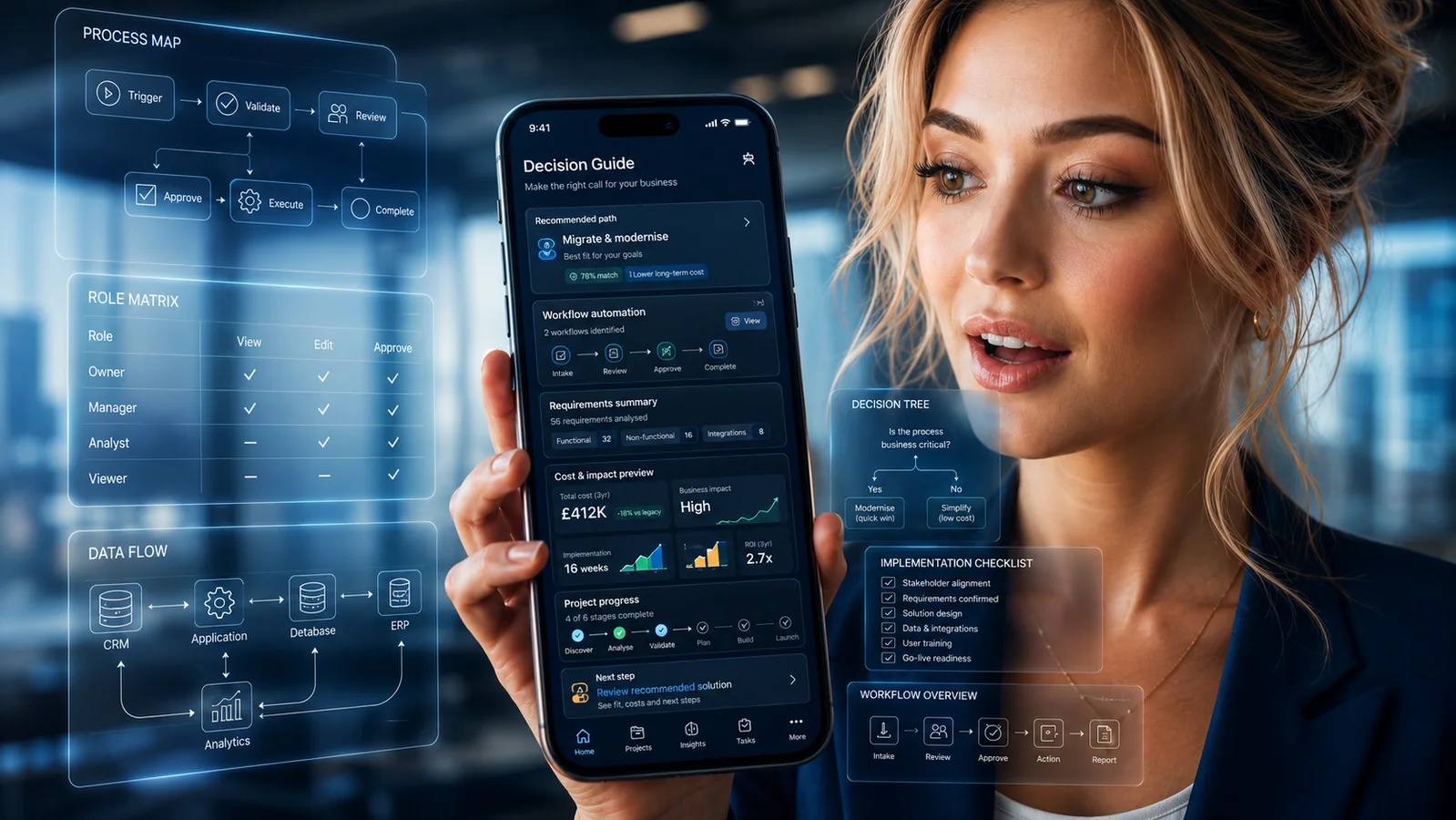
Start with the business problem
You do not need to know the technical answer yet. Begin with the decision, risk or operating problem you need to solve.
We have outgrown spreadsheets
Versions, permissions and manual rekeying are becoming operational risks.
Find the right starting pointWe need a customer portal
Customers need secure access to documents, requests, messages or services.
Find the right starting pointWe are planning SaaS
Define the MVP, tenancy, billing, onboarding and operating model.
Find the right starting pointWe must take over a legacy app
Recover control of code, infrastructure, data, access and documentation.
Find the right starting pointWe need integrations
Map data movement, ownership, failure handling and reconciliation.
Find the right starting pointWe need to choose a supplier
Compare evidence, assumptions, delivery controls and long-term ownership.
Find the right starting pointA complete map of the software lifecycle
Each guide starts with a business decision and leads to the supporting requirements, cost, risk and operating materials.
Web Applications
Plan, specify, commission and operate web applications around real business processes.
SaaS Development
Shape an MVP, choose an operating model and grow a SaaS product without losing control.
Business Systems
Improve CRM, portals, workflows, document handling and internal operations.
Technology and Integrations
Connect systems, manage data, choose infrastructure and design reliable operations.
Legacy Systems
Audit, take over, modernise or replace ageing applications with a safe transition plan.
Project Management
Set requirements, compare suppliers, control delivery and accept software with evidence.
From problem to ownership
Good software decisions are made in sequence. Skipping early questions usually creates expensive problems later.
- 01
Problem
Define the operational problem and desired outcome.
- 02
Process map
Capture the current process, roles and exceptions.
- 03
Requirements
Describe functions, data, quality and acceptance.
- 04
Build vs buy
Compare fit, control, cost and exit options.
- 05
Discovery
Test assumptions before committing to delivery.
- 06
Delivery
Build, review and control change in evidence-based stages.
- 07
Acceptance
Verify real workflows and sign off against criteria.
- 08
Ownership and support
Keep control of assets, operations and future change.
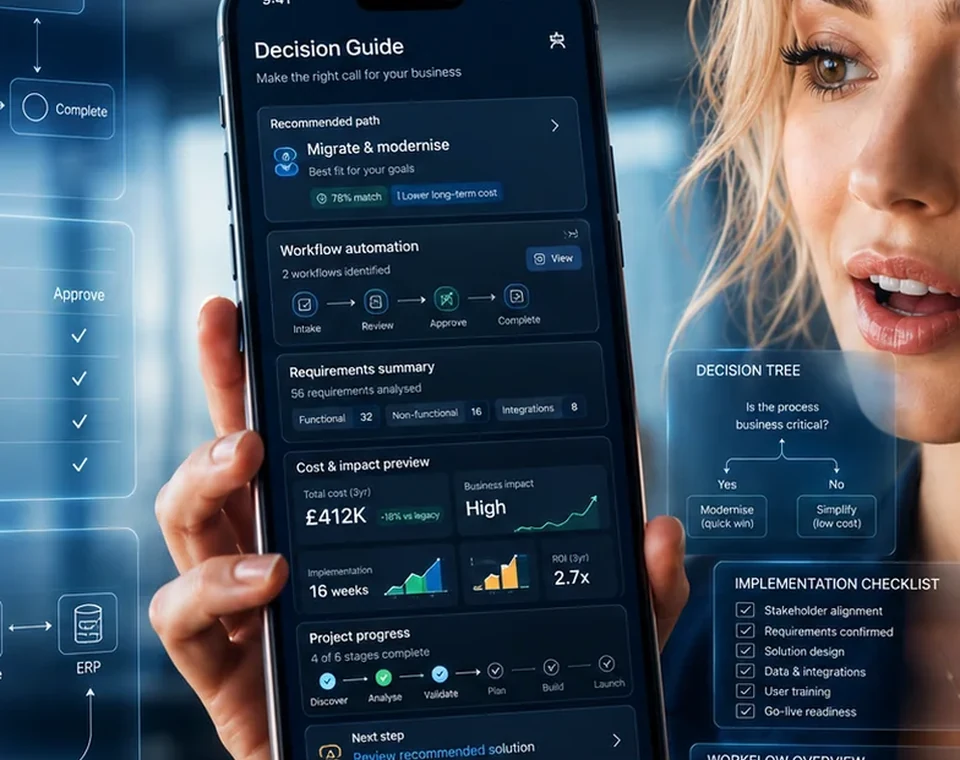 Decision path · requirements · cost · ownership
Start with the decision — not a technology shortlist
Most software projects go wrong before development begins. The guide helps you define the operating problem, identify the evidence you need and move to the right specialist material.
Compare options by evidence, not sales claims
Use clear criteria: process fit, implementation effort, control, ongoing cost, risk and the ability to exit.
Website vs web application
Choose between publishing information and running an interactive business process.
Read the guide ComparisonReady-made vs custom CRM
Compare process fit, integration effort, ownership and long-term cost.
Read the guide Legacy decisionRebuild vs modernise
Assess technical condition, business risk, migration and continuity.
Read the guide StrategyBuild vs buy business software
Decide what should be configured, purchased or built around your advantage.
Read the guideBudget beyond the build
Discovery, licences, integrations, hosting, monitoring, support, change and exit all affect total cost.
Ownership is more than source code
- Business accounts Domain, cloud, repositories and billing access
- Operational evidence Backups, monitoring, runbooks and deployment process
- Exit readiness Data export, licences, documentation and transition support
Questions that protect day-to-day operations
Security is only one part of assurance. Permissions, recovery and evidence must also work in the real operating model.
Security
Threats, authentication, dependencies, data and specialist review.
Permissions
Roles, approvals, least privilege and access reviews.
Backups and recovery
Recovery objectives, restore testing and operational ownership.
Audit logs
Record material actions without collecting everything indefinitely.
Newly published
SaaS Compliance and Data Protection
Compliance in a SaaS product is not a single regulation you satisfy and move on from. It is the ongoing alignment of your software's design, operation…
What Happens to Your Code If a Developer Closes Down
If a developer or agency stops trading, the business does not automatically lose its application. The practical outcome depends on ownership terms, re…
Waterfall vs Agile: What Business Owners Should Understand
The terms "Waterfall" and "Agile" describe how a software project is organised from the first conversation to the final handover. They are not technic…
Budgeting for Legacy System Modernisation
Modernising a legacy system is not a single purchase. It is a programme of work with distinct cost phases, and the total figure depends heavily on wha…
How to Plan for Web Application Performance
Performance planning means deciding, before a system is built or modified, what response times and reliability levels your users actually need and wha…
How to Choose a CRM for a UK Small Business
Choosing a CRM for a small UK business is not primarily a software selection exercise. It is a process-mapping exercise that ends with a software deci…
Clear about what the guidance can and cannot do
Researched and referenced
Time-sensitive claims are checked against authoritative sources and dated where appropriate.
Independent framing
Options are compared by business fit, cost, control and risk rather than affiliate position.
Corrections welcome
Material errors are corrected transparently. Readers can contact the editorial team.